There is a moment that happens around the tenth song.
You have been playing with Suno, typing prompts, hearing what comes back, sharing one or two with friends, and somewhere around the tenth creation, something shifts. You stop thinking of yourself as someone who prompted a machine and start thinking of yourself as someone who made something. You build a playlist. You come back to listen. You put your own song on during your commute and feel something that is hard to name but unmistakable: pride, maybe, or ownership. Authorship.
That moment is why Forerunner is investing in Suno.
Not a Better Tool; A New Behavior That Turns Listeners Into Creators
We see Suno not just as a music tool. It is a new form of entertainment — creative entertainment — that sits closer to cooking or journaling than it does to GarageBand or Spotify.
The distinction matters. Tools improve existing workflows. New behaviors create new ones. When Suno works, it is not making music production faster. It is enrolling people who never thought of themselves as music-makers into the act of making music. That is a population orders of magnitude larger than the market for any professional or prosumer music software that has ever existed.
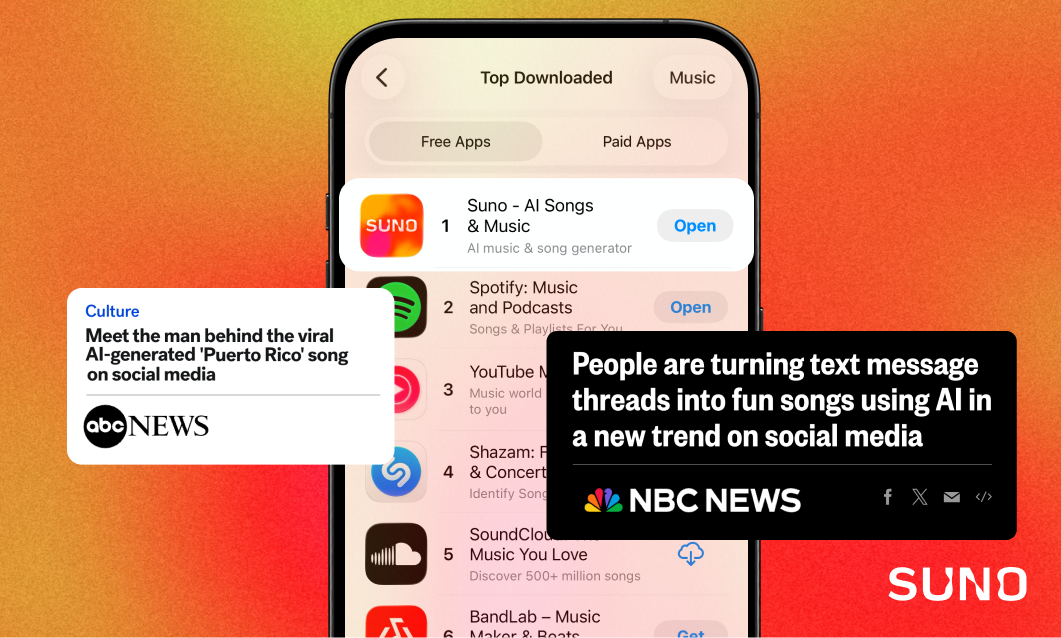
The behavioral evidence is already accumulating. The fastest-growing segment of Suno's user base reaches beyond the professional or the bedroom producer. It is the person who made a silly song for their kid's birthday and then couldn't stop. It is the teenager turning a text thread into a track and posting it before the conversation ends. It is the parent and child co-creating something in the kitchen on a Sunday that they will listen to together for years. These are ordinary people who have crossed the threshold from consumer to creator, and once you cross it, you do not go back.
Three Conditions Converged: Technology, Culture, and an Industry Finally Ready
We have been watching the cultural conditions for this company for a long time.
The first condition is technical. The quality of AI-generated music crossed a meaningful threshold in the last 18 months. It is the difference between a demo that impresses and a song that moves. Suno's model is now producing music that non-musicians want to listen back to, which is the only threshold that matters for the consumer behavior we are describing.
The second condition is cultural. We are living through a time when automation is making effort cheap, and people are increasingly paying a premium for things that feel genuinely theirs. This dynamic is showing up across every category we watch: in food (cooking at home surged not because takeout got worse but because making something yourself became culturally meaningful again), in craft (the resurgence of knitting, ceramics, sourdough, all of it), in fitness (people choosing to run harder courses, not just track their steps). Creative entertainment is the next category to feel this pull. Suno is building the default infrastructure for it.
The third condition is structural. The music industry's relationship with fan participation is finally evolving from liability to opportunity. Labels that spent a decade litigating fan creativity are now calling participatory media their next growth vector. Suno is positioned not as an adversary to that system but as its native platform, with the Warner partnership, the Songkick acquisition, and an emerging artist revenue-share architecture already in place. The scaffolding for a genuinely new music economy is being built, and Suno is building it.
A Team Who Sees Music as a Human Experience to Transform, Not a Market to Capture
We invest in people who see a category clearly before anyone else does and then build with the discipline to actually get there.
Mikey Shulman and the Suno team see music the way the best founders we have backed see their categories: not as a market to capture, but as a human experience to transform. Mikey's framing that Suno is creative entertainment, that the goal is to give everyone the experience of having made something, is not a pitch. It is an organizing principle that shapes every product decision, every partnership, every hire. We have seen what that kind of founder clarity produces at scale, and we trust it here.
The depth of the team, in AI research, in product, in the music industry relationships that matter, is what allows Suno to operate at the frontier of model capability while staying grounded in what ordinary users actually feel and do. That combination is rare, and when building for the consumer it is an essential superpower.
The Enduring AI Companies Will Automate the Task Without Automating the Purpose
The enduring AI companies will be the ones that automate the task without automating the purpose. Suno has that emotion. That tenth-song feeling of authorship, the behavior of coming back to listen to what you made, is showing every leading indicator that we have learned to trust across fourteen years of consumer investing.
We believe Suno is building a new leisure category. We believe creative entertainment will be one of the defining consumer behaviors of the next decade. We believe the team to build it is the one already doing it.
And we believe the person who made their tenth song and felt something — who is, increasingly, everyone — is only at the beginning of understanding what this product will become for them. We are proud to be part of that.